This little farce was the result of some after rehearsal drinking and gabbing. It was our custom after an evening's rehearsal at the KIMBELL MUSEUM to move over to J&J'S HIDEAWAY, a watering hole on 7th Street in Fort Worth which is now sadly no more, to have a few beers and talk about whatever entered our heads. OLD TARZAN happened this way as did LUCY & DESI vs THE KILLER SHREWS. Much in the same way that JOHN MURPHY and RIC SWAIN had made the perfect ABBOTT & COSTELLO MEET FRANKENSTEIN in 1984, we all thought that DENA BRINKLEY and PETE TAMEZ (last seen in MIRANDOLINA '84) would be the perfect LUCY & DESI.
But in what vehicle? We hashed this around for awhile...more beer! Somehow a discussion of
THE KILLER SHREWS, an obscure Drive-In flick made by legendary broadcaster GORDON MCCLENDON in Dallas in 1959 caught our fancy....More BEER!
Finally I came up with the great idea of combining the two. It was stupid and simple...Somehow Lucy accepts the delivery of a crate that turns out to contain the aforementioned SHREWS and all hell breaks loose as the cast is taken out one by one. I said that I would write it and we agreed to put it first on our schedule of shows UPSTAIRS AT THE WHITE ELEPHANT the next February, 1987.
I had TWO MONTHS to deliver...No Problem!.....MORE BEER!!!!!!
Tuesday, September 17, 2013
Monday, September 2, 2013
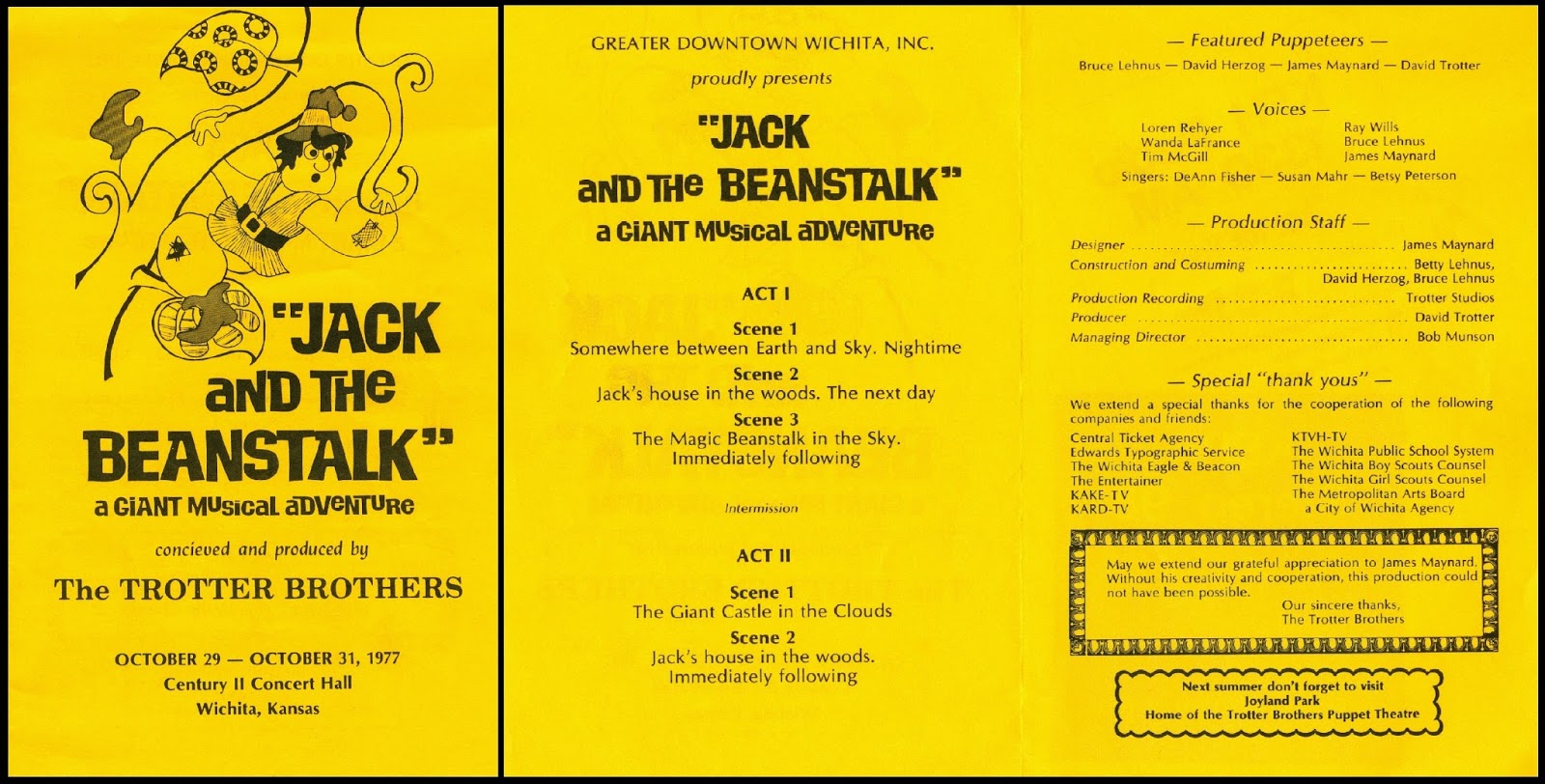
JACK & THE BEANSTALK Program & Article
It was a Good Show and very well received on it's premiere engagement at Century 21 in Wichita, Kansas...our home base.
Here is the original program and the article which highlighted how one of the TROTTER BROTHERS productions came to the stage back in 1977.
JACK & THE BEANSTALK Sketches
Unfortunately, and rather typically...my renderings for JACK & THE BEANSTALK's puppets and sets remained with the TROTTER BROTHERS after I left the company and I have no idea where they are today or if they still even exist.
I did find these two rough sketches which actually were more important as they detail the touring stage set-up and materials.
At the left is a breakdown of the TROTTER's touring stage, used for all the full stage productions. This was constructed of aluminium tubing joined together with couplings and allen wrenches. Each tube section was 6' long. The entire stage was 12' high and 30' wide with the proscenium opening for the Hand and Rod puppets being6' tall and 15' wide in the center. The entire framing was covered with black velvet attached quickly with velcro fastenings. The stage could be set up and ready to perform within 2 hours of unloading and could be struck and packed up in less than an hour. On tour this was crucial, as we often played only one evening and had to be in the next town by afternoon on the following day. If you have never done this sort of thing I can't begin to describe how it feels, except that you learn to covet two things: a decent place to eat, and even more importantly, a good place to wash your cloths!
Along with the main stage setup were several rolling stands ( a castored base with an aluminium pole attached). These supported both scenery and puppets as needed and could be interchanged.
In the second photo are sketches for the show opening banner. Two huge butterflies flit in Black-Light around the stage before opening this fluorescent banner proclaiming the name of the show. This led into the opening scene between the MAGICMAKER and the MAN IN THE MOON following the MAGICMAKER's expulsion from his castle in the clouds by the GIANT which starts the play. All this opening was in Black-Light prior to the first scene of the play. The Sets were two-sided flats on castored stands which floated in from the wings and formed the scene before the audience's eyes; first the house of JACK and his MOTHER between the trees of the forest, abd then in Act 2 they swiveled in place to form the castle of the GIANT among the clouds. Pretty nifty.
The most important effect was the Beanstalk which had to appear to "grow" in real time on stage. The second photo shows how this was accomplished. Like the MAGICMAKER puppet, the Beanstalk was constructed with a covering and leaves made of fluorescent materials. It was mounted on a frame which stood behind the Act 1 setting. A black velvet cloth 7.5' wide and 13' long was draped over this, with a batton affixed at it's back. First, a gloved hand depicting the sprouting stalk was shown writhing up from the proscenium, then the drape was slowly pulled back, and the jagged edge of the bottom reveiled the black-Lit stalk as it was drawn up and over. After this the stage lights were brought up and JACK was able to climb the stalk aided by his "Legs" which were sewn to his black sleeve. Clever, huh?
JACK & THE BEANSTALK Puppets 3
In the second act of the show the GIANT appears on stage just in front of the puppet proscenium as an 8 foot tall costumed human actor. After watching the show in puppet scale this was a shock to the audience as well at to JACK. Here is the GIANT'S Head next to the Jack puppet. It was built of foam rubber over a wire armature attached to an actual football helmet. One hand of the performer operated the GIANT's mouth and wires that could close and open his eyelids for either wide-eyed rage, or the sleepy-eyed look needed when the HARP played it's lullaby. The other hand went into a glove to move the GIANT'S right hand ( the Left Hand was stuffed and attached to a wire that raised and lowered it in conjuction with the Right hand's movement when needed.
At the right in the photo is me with the JACK Puppet just after it was finished and tested. This test convinced the TROTTER BROTHERS that the technique would work so that we could proceed with the production. In case any of you feel that my brilliant ideas and designs spoke for themselves over the years...dream on...I've had to "Audition" my work countless times, and have been rejected even more. Such is the theatre...the Bottom Line will always rule and must be FED!
JACK & THE BEANSTALK Puppets 2
I styled the JACK & THE BEANSTALK puppets with vaguely Russian costumes. I'm not remembering why exactly, except that I may have wished to separate this shows look from the previous one somehow.
The MAGICMAKER character, seen here with JACK was both the Narrator of the play and the chief instigator of the plot. It was HIS castle in the clouds which the GIANT had stolen. HE sells JACK the magic beans which grow the Beanstalk, etc. This was not only a colorful character, but he was fashioned entirely from Fluorescent materials. During key scenes he would be shown flying with the aide of a Magic Umbrella, and tho sequences were lit entirely by Black-Light.
In the second photo is BETTY LEHNUS, who built this show with me for the TROTTER BROTHERS. Betty is an accomplished puppet builder in her own right, claiming that she learned from us at the studio, but her talent comes from within. Some have it and some don't. I was grateful for her assistance and ideas and encouragement.
Some years later She and I started our own costuming business building Mascot costumes for schools and businesses, and costuming childrens theatre productions... and the PUNCH & JUDY puppets I've posted about earlier.
More about that business in later posts...
JACK & THE BEANSTALK Puppets
As I've said before, RAY MOORE is a genius as both a designer and puppet builder. I will never aspire to his talent, although we have worked together and he is a gracious and generous man.
The top two photos show the puppets he created for the TROTTER BROTHER'S production of HANSEL & GRETEL. These were beautifully sculpted and finished with very technical controls which allowed intricate head and hand movements. The FATHER, MOTHER andf WITCH puppets were 36" tall with hand and rod manipulation. The puppeteer had a touch-sensitive controller which allowed the head to be nodded and swiveled from side to side, while the hands were controlled by black rods, so attached as to allow for very human-like movement and gestures. HANSEL and GRETEL and the other characters where slightly smaller hand puppets ( three fingers controlling Head and Hands) and an array of forest creatures and Angels, some hand puppets and some on simple single rod controls. All really fine workmanship and all....
....really EXPENSIVE!
At least a quarter of the cost of this show lay in the puppets. My first task to bring in a more affordable production for JACK & THE BEANSTALK was to find a way to produce puppets which were full-stage worthy but not so expensive.
The bottom photo shows the solution. Instead of sculpted styrofoam and heavy felt covering, the JACK puppets were all made to the same design: Simple foam rubber Head and Body construction with cheaper flesh colored velveteen coverings. The hands were wire armature with velveteen, stuffed with polyester and a simple black cotton sleeve. Once the bodies were constructed as seen in the lower photo at the left, we finished and costumed them to create JACK and his MOTHER as seen in the right hand photo.
These puppets were not as heavy and were only capable of fairly broad movements ( No Head movement accept side to side turns, and simple hand gestures) but they performed acceptably and...
... Cost VERY LITTLE to create.
JACK & THE BEANSTALK Trotter Brothers 1977
I've posted before about my years with the TROTTER BROTHERS PRODUCTIONS and the Holiday and Amusement park shows I designed and mounted for them in the mid 1970's.
They also toured full stage productions utilizing 36" tall hand and rod puppets. They were doing a musical version of HANSEL & GRETEL designed by RAY MOORE of Atlanta when I joined the company and they wanted a second show to tour seasonally. After several pitches were rejected, my idea for JACK & THE BEANSTALK was accepted, mainly because I had figured out a way to incorporate a human-sized GIANT into the show and because I promised to bring the production in well under the cost of HANSEL & GRETEL.
I delivered on that promise by writing the show myself, book, music and lyrics...and designing modular rod puppets and scenery which could be shipped in a 15 foot U Haul truck, instead of the 30 foot rig needed for HANSEL & GRETEL and SANTA'S MAGIC CIRCUS. Just in case you're interested, the difference in cost per production was about $50K for HANSEL & GRETEL to around $10K for JACK. Even in 1977 that was a big number to recoup.
Above is a publicity picture of BOB and DAVE TROTTER with the GIANT character costume and some of the puppets from JACK & THE BEANSTALK, and a pic of me and the JACK puppet taken for a newspaper article profiling the making of the show.
Subscribe to:
Posts (Atom)